Why Your Water Tank Gets Dirty Faster in the Eastern Province
Heat, Gulf humidity, salt air, and dust all compound on your water tank, and none of them work the way Riyadh does. Here's what changes in the Eastern Province.
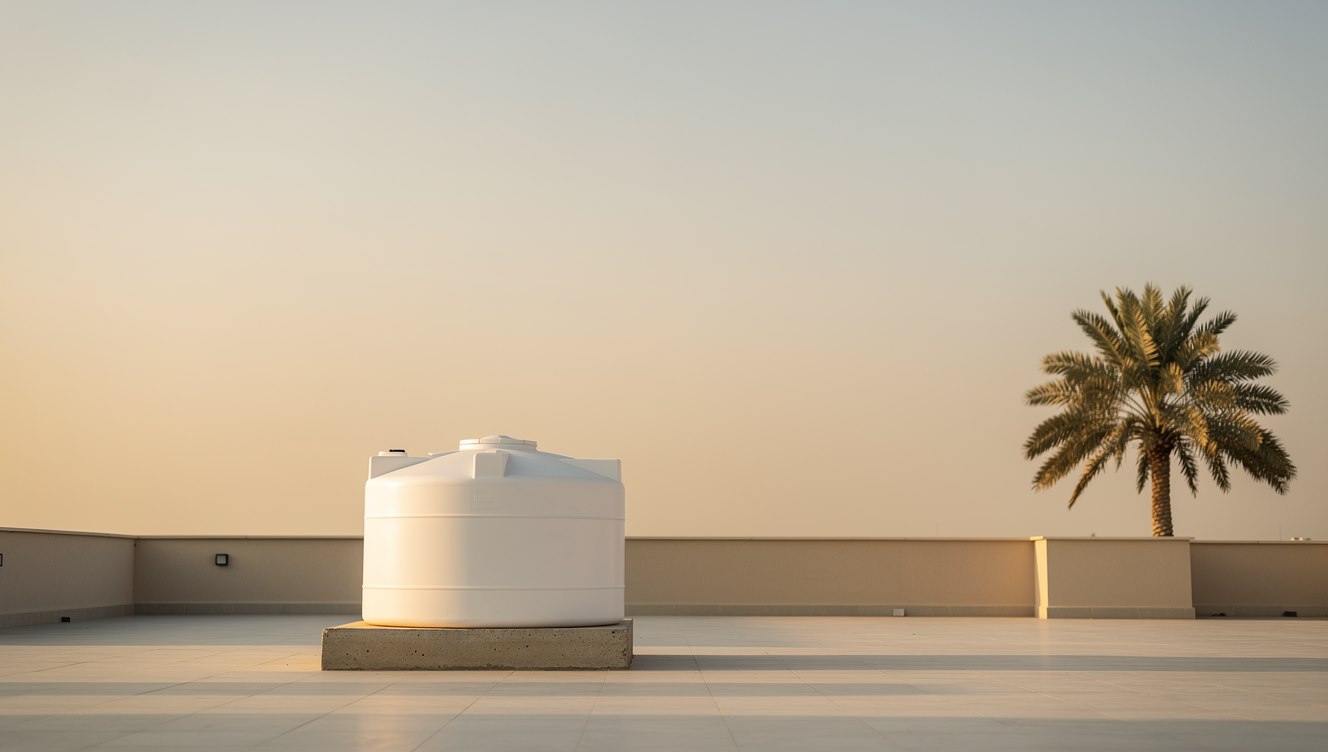
The Eastern Province: A Special Challenge for Your Water Tank
Living in Dammam, Khobar, or Dhahran means your home runs against a climate most of inland Saudi Arabia doesn't deal with. The same water tank installed in Riyadh and in Khobar will behave differently, sometimes very differently. Understanding why helps you set the right cleaning rhythm and spot trouble earlier.
Here are the factors at work, in the order they actually matter.
Heat: The Single Biggest Factor
In the Eastern Province, summer isn't a phase; it's a season that runs for months. According to the World Meteorological Organization, Dammam's average daily high is above 40°C from May to September. Tank surfaces (especially rooftop tanks) get far hotter in direct sun.
What that does to your water:
- Bacterial growth accelerates with temperature. According to the World Health Organization, the growth of bacteria such as Legionella can be controlled by keeping cold water below 25°C, outside the range in which they multiply. In an Eastern Province summer, water in a rooftop tank can stay above that for months.
- Algae can grow inside the tank. According to the World Health Organization, sunlight reaching stored water promotes algal growth, and a cover helps keep it out. So, especially in this heat, a lid that lets light through gives algae a chance to grow. Sealed tanks slow this dramatically but don't eliminate it.
This is the part many homeowners underestimate. They check the lid for dust, see none, and assume their tank is fine. But the temperature inside the tank (not the dust around it) is doing the slow work.
Humidity and Salt Air: The Coastal Multipliers
Humid, salty air near the Corniche speeds up the breakdown of seals and metal fittings, so tanks on the coast tend to need repairs and replacement parts sooner than tanks inland.
Humidity in coastal Eastern Province neighbourhoods (especially close to the Corniche) runs high in summer. Inside the tank, warmth encourages film growth on the walls. Outside the tank, heat and humidity accelerate the breakdown of seals around the lid. According to the World Health Organization, contaminants can get into a storage tank whose lid is cracked, severely corroded or no longer fits tightly.
Salt air corrodes metal fittings and inlet/outlet pipes. Older metal tanks rust faster on the Gulf coast than in inland Saudi. Even fibreglass tanks aren't immune; salt eats at the steel reinforcements in stands and at metal lids.
Dust: A Real but Limited Factor
Dust gets discussed the most in tank-cleaning conversations, but it's actually the smallest of the three climate factors for most tanks.
Here's the honest picture:
- A well-sealed tank keeps the vast majority of dust out, even during major dust events.
- An older or poorly-sealed tank (where the lid no longer seats properly, where vents are uncovered, where inlet pipes have gaps) does let dust in. Fine particles work their way through small gaps and accumulate at the bottom.
- After a big dust storm, a quick visual check is worth doing. If the water looks fine and the lid is intact, you don't need to rush a cleaning; the seal did its job.
The takeaway: dust matters for some tanks (older, poorly-sealed), and matters less for others (newer, well-maintained). It's never the only reason a tank needs cleaning; heat and humidity drive the underlying conditions, and dust adds to them.
How Often Should You Wash Your Tank in the Eastern Province Compared to Riyadh?
In the Eastern Province we recommend washing twice a year (every six months), with a third wash if the tank is a rooftop tank in direct sun, an older tank, or your household uses a lot of water. Many Riyadh homes get by with one wash a year.
Combine these factors and the picture is consistent:
- We recommend twice-a-year cleaning for Eastern Province homes: every six months. This catches sediment before it cements and resets the inside environment before significant film builds.
- A third cleaning is worth it if you have a rooftop tank in direct sun, a large household with high water turnover, an older tank, or visible water-quality changes.
- A post-storm visual check beats a rushed cleaning. Look. If everything is fine, wait for the regular cycle.
This is meaningfully different from a Riyadh-only schedule, which often gets away with annual or less frequent cleaning. The Eastern Province climate genuinely runs harder on your tank.
What Are the Benefits of Washing Your Water Tank Regularly?
Washing your tank every six months gives you cleaner water at the tap, a longer tank life and better water pressure. The service starts from 300 per tank and includes sanitising and a written report, with all packages on the tank cleaning page.
A well-maintained tank pays back in three ways:
- Healthier water at the tap: fewer bacteria, less biofilm pushing through to your kitchen and bathrooms
- A longer tank life: sediment that doesn't cement, seals that don't get attacked from inside, less premature replacement
- Better water pressure: outflow pipes that aren't partially blocked by years of accumulated grit
In a region where your tank is working this hard, the cleaning routine is matched to the workload, not to a generic national average.
Water tank cleaning is available across the Eastern Province: Dammam, Al-Ahsa, Qatif, Khobar, and Dhahran.
Living in the Eastern Province? Schedule a tank cleaning: book a water tank cleaning with food-grade chlorine safe for drinking water and a written report after every service.
Sources
- World Weather Information Service: Dammam climatological information, World Meteorological Organization, averages for 2001 to 2010.
- Guidelines for Drinking-water Quality, 4th edition, chapter 6, World Health Organization.
- Sanitary inspection form: piped distribution, storage tank, World Health Organization.